Thursday, 31 July 2008

WALL-E

WALL•E is filmmaking at its best. Forget the naysayers who stupidly dismiss an animated film as a kids movie, this film ranks up there with the best of Kubrick and Chaplin (to name two of the directors this film clearly got some inspiration from). The first half an hour or so, is pure visual storytelling, without a word of dialogue being spoken, Stanton manages to set the film in space and time and introduces us to the two main characters. WALL•E (Waste Allocation Load Lifter Earth-Class) is a character much like Chaplin’s tramp, incredibly lovable, someone we can all sympathise (or even empathise with) and much like in Chaplin’s films, there is virtually no dialogue (the two main characters hardly speak a word, aside from each other’s names) and the humour is mostly physical. The animation is top-notch, probably one of the (if not the) best ever and the amount of emotion the characters express through their “drawings” is truly unbelievable. They are only robots, and yet they felt so undeniably human. In fact, I think EVE and WALL•E’s romance is as touching as any of the best romances portrayed by real actors. And it’s all in the details.The lack of dialogue is replaced with some fantastic visual storytelling.

The first shots of the film get us acquainted with the world “today”: stark, sad and desolate and then we finally get a glimpse of the last robot that remains on Earth. With no other robots (or humans) around, WALL•E only has a tiny little cockroach to keep him company (and who knew cockroaches could be so cute?) We follow the adorable robot and his friend for a while, as he endlessly piles rubbish cube after rubbish cube but we immediately realise there’s something different about this robot: he occasionally finds “little treasures” (Rubik’s cube, lighters, light bulbs) that he carefully keeps in his home as his private collection. One particularly important item for WALL•E is a video tape of ‘Hello, Dolly!, which is greatly responsible for his “humanization”. He’s fascinated by dancing, but more importantly, by love (as he sees the characters holding hands and whatnot). WALL•E’s mundane existence, however, suddenly changes when a new robot comes to Earth. 

EVE (Extraterrestrial Vegetation Evaluator) came down to Earth with a mission: to find a source of life and bring it back to space so that humans can return to their homes. Although not as immediately obvious as WALL•E, EVE is not an entirely normal robot either as she seems to enjoy flying and occasionally even giggles, but at first she is not interested in his stalker friend WALL•E, who is clearly fascinated by her and continually follows her around (only to fall deeply and madly in love with her). Eventually, the two robots meet properly and WALL•E takes her to his special place, where he starts showing her his most valued objects. Among those, however, there’s a plant and when EVE sees her she automatically grabs it, puts it inside of her and shuts down, waiting for the ship where she came in to return and take her back to space again. WALL•E, already in love and unaware of her mission, however, takes care of her day and night (protecting her from rain, taking her out on “dates”), until one day, the space ship comes back to take her. Nevertheless, he somehow manages to follow her and their space odyssey begins. 

The film is a commentary and critique on today’s society values, sure, and the idea that humanity’s “last hope” is a robot (more humane than any of the robotized “real people”) is highly ironic, but at the core of the film there’s a love story and that’s what makes the film particularly special. The chemistry between the two robots, WALL•E’s undying, passionate love for her, EVE’s sudden realisation of her own feelings (in what’s perhaps my favourite scene of the film) and everything related to these two are what make this film as wonderfully touching as it is. It’s PIXAR’s most ambitious and mature work to date and in that it loses some of the humour of the rest of the films and is instead much sadder, but in turn it gains points for pushing the boundaries of animation and creating one of the most powerful, visually arresting, and incredibly moving films of all time.

Personal rating: 9/10

Thursday, 24 July 2008

La Double Vie de Véronique (The Double Life of Veronique)

Kieslowski’s film is of such ethereal beauty as is the star of the film herself. Indeed, this film seems more like a love letter for the wonderful Irène Jacob who appears in almost every frame of the film as the title character. First as Weronika in Poland, an amateur singer of extraordinary talent, a stargazer of the purest form of innocence, a child in a woman’s body almost, a free spirit of incomparable openness. In the film’s most powerful scene, however, she unexpectedly dies during her debut performance. Cue Véronique, a French music teacher, played by the same actress. Both women seem to be aware of each other in a deep subconscious level. Werokina feels that she is not alone in the world and when she dies Véronique suddenly feels like she lost someone. Moreover, Véronique seems to act upon instinct, like there’s someone whispering to her what she should or shouldn’t do. In fact, after Weronika dies, she decided to drop her singing lessons because “something” told her to do so; and as the film advances we learn that that wasn’t the first time Véronique “learned from Weronika’s mistakes”. Add to the story a mysterious puppeteer, Veronique’s love interest if you will, who is somehow linked to the two women and you have this film’s basic “plot”. 

The similarities between the two are obvious beyond the fact that they look the same physically. Both exude a mysterious aura of purity and generosity of spirit, but Veronique appears to be the more practical of the two. These women share a bond, but the degree to which they are connected is something the viewer has to decide for theirself. Are they the same person? Do they share a soul? What does the puppeteer represent? Could he be Kieslowski or God? Or is Kieslowski actually represented in the title role? What is the meaning of the ending? These are some of the questions this film might raise, but the answers to all of them can only be found in oneself. 

The director takes joy in showing us the little details that make this character so absolutely fascinating and perfectly connects their stories through the recurrence of objects (threads, a little toy balls), people (fathers, missing mothers, old hunched woman – also in Three Colours: Blue, I think), colours, places and camera angles, making the feeling of déjà vu all the more intense. The cinematography is strikingly gorgeous, the colour palette (predominantly of yellow hues) and lighting all working together to give the film a dreamlike look. The beautifully atmospheric music works both as a contributor to the highly spiritual vibe of the film and as a powerful reminder of the connection of the two women. But if there’s one element without which this film couldn’t have worked it’s Irène Jacob and her luminously humanistic performance. Her dreamy eyes, her delicate beauty, her innocence and purity are incredibly compelling. Dialogue wasn’t needed at all. In fact, she could have delivered an equally impressive performance if this film had been silent because it is in her body language and especially in her eyes where she conveys emotion.

The Double Life of Veronique is a film which doesn’t need to be explained for one to appreciate it. It is true that it’s an incredibly metaphysical piece of work, but in philosophy it’s all about the questions, not the answers; and believe me when I tell you, Kieslowski definitely understands that.

Personal rating: 9/10

Wednesday, 23 July 2008

Happy Birthday Philip Seymour Hoffman!

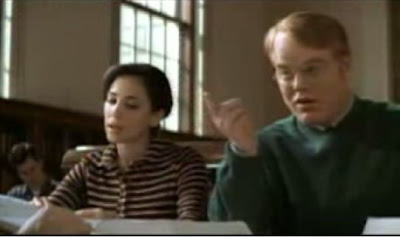
So, today is my favourite working actor's birthday, so I decided to do a little post about him. I discovered him back in 2005 with the release of the Capote trailer. Rather late, I know, since he was already famous for being one of the best character actors around, stealing scenes in supporting roles and even leading a few independent films as well. However, it was with the trailer of this particular film that I first noticed him and that's when I decided to do some research on his work. Needless to say, he blew me away in every single film of his I saw and then with Capote he was ready to top my favourite actors list.

What follows are all of the Philip Seymour Hoffman performances I've seen ranked in order of preference (but they are all extraordinary):

1. Truman Capote in Capote (2005)

Personal awards: Best Actor* (2005)

2. Andy in Before the Devil Knows You're Dead (2007)

Personal awards: Best Actor (2007)

3. Dean Trumbell in Punch-Drunk Love (2002)

Personal awards: Best Supporting Actor (2002)

4. Jon Savage in The Savages (2007)

5. Gust Avrakotos in Charlie Wilson's War (2007)

Personal awards: Best Supporting Actor (2007)

6. Dan Mahowny in Owning Mahowny (2003)

Personal awards: Best Actor (2003)

7. Phil Parma in Magnolia (1999)

8. Rusty in Flawless (1999)

9.  Jacob Elinsky in 25th Hour (2002)

10. George Willis, Jr. in Scent of a Woman (1992)

Personal awards: Best Supporting Actor (1992)

11. Allen in Happiness (1998)

Personal awards: Best Supporting Actor (1998)

12. Lester Bangs in Almost Famous (2000)

Personal awards: Best Supporting Actor (2000)

13. Freddie Miles in The Talented Mr. Ripley (1999)

14. Joseph Turner White in State and Main (2000)

15. Brandt in The Big Lebowski (1998)

16. Sandy Lyle in Along Came Polly (2004)

17. Owen Dawian in Mission: Impossible III (2006)

18. Scotty J. in Boogie Nights (1997)

19. Reverend Veasey in Cold Mountain (2003)

20. Freddy Lounds in Red Dragon (2002)

21. Charlie Mayne in Empire Falls (2005) (TV)

22. Dustin Davis in Twister (1996)

23. Mitch Roman in Patch Adams (1988)

* Indicates win.

I apologise for the poor quality of some of the images, but it was impossible to find better ones. 

Anyway, happy birthday to the best actor of the generation! And here I leave you with a little something, a taste of his talent. One of the funniest performances of the decade, no doubt:

Sunday, 20 July 2008

The Dark Knight

So, I haven't updated in a while. But I've probably seen more films this month than any other in the year. Anyway, what follows isn't exactly a review, there are virtually no plot details (no spoilers either), but a collection of thoughts on the film. 

The Dark Knight is undoubtedly one of the most ambitious films to come out recently and this is both what makes it so great and what makes it fail. The film tries so hard to be taken seriously that if there weren't any fantastic costumes or over-the-top makeup this would be the crime film that has garnered such valid comparisons to films such as Scorsese's The Departed; and Mann's Heat. Nolan's vision strays from the campy Burton films and attempts to be as realistic as possible, but it's not one thing or the other, rather, it falls into an awkward middle, and this is the The Dark Knight's most glaring flaw. This problem stems from the screenplay, which is rich in characterization (especially when we consider it's a sequel to Batman Begins, which gave us enough insight into Bruce Wayne/Batman's character) and incredibly smart in terms of plot and story (although some suspension of disbelief is required, but isn't it always?), but the dialogues leave much to be desired. The film had a very uneven tone and couldn't avoid falling into those campy/cheesy moments every superhero movie has. While those moments feel natural in films like Spider-Man, here they stood out too much and simply didn't fit the atmosphere Nolan was attempting to create. This is why, in my opinion, some of dramatic scenes aren't as effective as they should have been. Moreover, the three storylines are very well-linked in terms of content (the two extremes Batman - Joker and the man in the middle, Two-Face) and in terms of screen time devoted to each one of them; however, the second half of the film felt incredibly rushed, a continuation of build-ups to moments of climax and anti-climax and then the film ends almost abruptly. 

Now onto the characters and performances: Christian Bale is one of my favourite actors, but he was a tad disappointing. Yes, his Batman voice is awful, but that's not it. Perhaps it's because four other members of the cast completely outshined him, or perhaps it's more related to the material he had to work with, but he wasn't entirely convincing this time around. It's a difficult role, nevertheless, not only given its duality but also the fact that Bruce Wayne, the rich playboy, is in fact a man pretending to be a rich playboy. In this, Bale succeeds, superficially looking blasé and also, when the situation requires it, having that glint in his eye, almost like a knowing wink to the audience, saying that there’s another man underneath all that pretence (the "double date" at the Restaurant comes to mind). 

Jim Gordon is probably the most human character in the film, and Oldman more than makes it justice. He gives Jim such humanity, a sense of justice and pathos, making him the most approachable character in the film. A very restrained, subtle turn from Mr. Oldman that looks like it'll be the most overlooked performance of the year, unfortunately.

Aaron Eckhart, another one with a character of dual nature (in the most literal sense!), is incredibly charismatic as the newly appointed D.A. and incredibly chilling (and devastatingly sympathetic) as Two-Face. The effectiveness of this character is one of the screenplay's strongest points. We spend so much time with Harvey Dent that seeing him become Two-Face is especially tortuous. Harvey Dent feels more like an idea than an actual human being, which makes his whole descent into madness all the more real and, yes..., human. He is the hero with a face that Gotham needed, morally righteous, ambitious, determined to the point of being stubborn;, a daredevil, even. However, he is a human and he can be broken. Enter Joker.

The Joker is such a primitive, extreme character, so devoid of any real humanity that to be able to portray him without him becoming a caricature is no small feat. Prove of that is Jack Nicholson's amusing, yet absurdly self-indulgent attempt in Burton's Batman. Heath Ledger's turn is, quite simply, astonishing. His performance is what his character becomes in the film, an unstoppable force. What he creates is so real, so natural, so fresh and exhilarating. He is brilliant in every aspect of the performance, from the mannerisms and physicality (the constant lip-licking, the eyes giving quick glances to the side, the chilling voice, the body-language, his slightly hunched posture), his body movements are so spontaneous, his sudden bursts of laughter and perfect comedic-timing, and then the depth he manages to give a character with no real "depth" at all. He is an agent of chaos, as he says, but he doesn't so much want to create chaos but to prove order wrong and Heath Ledger's performance embodies all of that. It was inspired casting, no doubt, but the results exceeded all expectations. Who knows how many more earth-shattering performances this man could have given?

The rest of the cast is uniformly great. Maggie Gyllenhaal creates the perfect balance in her character; she is sexy and feminine, yet strong. Her role is extremely underwritten and the material she has to work with is particularly poor, but she gives it her all and the results are very good. Tell me if you weren't moved by her final scenes! Michael Caine and Morgan Freeman are their usual charming selves, acting as Batman's conscience and voice of reason. 

The score is one of the best improvements from Batman Begins and now feels complete, although I still find it slightly underwhelming. The action scenes are poorly shot but entertaining nevertheless. In fact, the cinematography is not quite as striking as its predecessor. But just what makes this film so special? Is it deserving of the almost unanimous accolades it's receiving? For a film so dark in nature and so serious in tone (even the tagline refers to this) it can't get away from the cheesy dialogues and general over-the-topness and ends up slightly alienating the viewer. Nolan wants so much to transcend the original medium but falls short and even runs out of steam at the end. However, the two and a half hours fly in this highly entertaining film. The characters are very well-drawn, richly characterized and incredibly well-acted. The story (although much is left to the viewer's interpretation) is incredibly smart (also highly intricate) and deals with several themes, and at the core of the film there's the question: is it possible to be decent in a world full of corruption, and more importantly, for how long can one fight it and what does one have to give of theirself to do so?

Personal rating: 8/10

Wednesday, 2 July 2008

The Incredible Hulk

First of all, this really is a step forward in the right direction after the disaster that was Ang Lee's 'Hulk'. That being said, this is not a very good film. It works as a summer blockbuster just fine but it's not generally a good film, and this year's Iron Man is certainly the better of the two. It seems that The Hulk is a rather troublesome character to adapt to the big screen because of its particularly complex dual nature. It is true that most of these films deal with the issue of having "2 identities", but in the case of the Hulk, he is not your average superhero and he despises his condition more than anything in his life.

So the film starts with a very inventive and rather effective sequence of credits where the beginning of the Hulk (Edward Norton) is explained. In a couple of minutes the film covers the accident in the lab and Bruce Banner's subsequent retreat to an unknown location. That location is a favela in Brazil where he practises different relaxation techniques and where he's actively looking for a solution to his problem. On the other side of the world, William Hurt (a U.S. military general) the man who was in charge of Bruce Banner's scientific research and father of his ex-girlfriend (Liv Tyler) is desperately looking for him and hires a combat veteran, Emil Blonsky (Tim Roth), to help him with his quest.

The main problem with this film is that it tries to be many things but only succeeds at one: being an action film. The action sequences are undoubtedly fun and the special effects are quite impressive; the Hulk himself, although looking nothing like Edward Norton, is incredibly well-done. But then most of the dramatic scenes in the film are very poorly done and even cliched. This problem stems from the screenplay, which is very flawed. The characters have no depth to them at all and while that is not a major problem for a character like Blonsky, who we just want to see as the unstoppable bad guy, it tends to detract from the film when it is so difficult to care for the good guys. So, we know Bruce Banner is not content with his current situation but that's about it as far as "character development" goes. Moreover, Liv Tyler's character is laughable; we first find that she has moved on after Bruce’s disappearance and that she is in a serious relationship with some guy, but as soon as he sees Banner, she is able to forget all about her recent life, which is not even mentioned again. William Hurt's character is perhaps the one with the most solid background and the least 2-dimensional of the bunch, but then that's not saying much. Most of the performances are solid: Edward Norton is fine but not thoroughly convincing, which probably isn't his fault anyway, and both William Hurt and Tim Roth are very good. Liv Tyler is without a doubt the weakest link in the cast, with her unbearably monotonous voice and overall flaccid persona, but she had the worst character of the film, so it wasn't that terrible all things considered.

Despite all the above, this really is an enjoyable film. The editing is probably what saves the film from disaster because the film's strongest point is its vibrant pace which keeps the viewer engaged even during action-less scenes. The build up to seeing the Hulk in its entirety is perhaps a cheap technique but a very effective one. We are able to catch bits and glimpses of the creature for the first part of the film and then when we finally lay eyes on the whole thing, it doesn't disappoint. Overall it's a film that flies by and keeps you entertained all throughout with decent performances and killer special effects. Recommended if you like this genre.

Personal Rating: 6/10

Monday, 30 June 2008

The Cook, The Thief, His Wife & Her Lover

It is hard when dealing with films of allegorical nature to refer to its plot, because the actual plot is simply not meant to be taken literally, rather it serves as a metaphor for something much more general and universal. However, for this to work the film needs to work on a literal level as well and Greenaway's film unquestionably accomplishes that. Albert Spica (Michael Gambon) is a gangster, owner of the restaurant where most of the film takes place and where he dines daily accompanied by his wife Georgina (Helen Mirren) and a bunch of yes-men (a young Tim Roth among them). Spica is as loud, vulgar and abominable as a character can get and he is seen continually tyrannizing everyone around him including the suffering wife, silent and mysterious. Despite the abhorrent behaviour of Spica and his men, the restaurant is not without clients, all looking like the quiet subdits of the omnipotent dictator. The restaurant's chef, Richard Borst (Richard Bohringer), an expert at his craft, seems oblivious to Spica's depravity as he dishes out his fine cuisine to the uncultured mouths of the gangsters, but he finds a worthy consumer in Georgina, who he says has exquisite taste and to whom he prepares especial dishes. It is deduced that all of this happens routinely, until one day a customer's and Georgina's eyes suddenly meet and they are both enthralled by each other. This man, Michael (Alan Howard), looks like the complete opposite of Albert: intellectual, cultured, a book-lover and it is soon after they see each other for the first time that they meet, silently (for not a word is spoken), in the bathroom. Thus begins their affair; their love-making sessions occur during Georgina's bathroom breaks (later at the kitchen, aided by the cook) as Albert becomes more and more suspicious of her wife's recurrent visits to the toilet.

The film is full of symbolism, not only in the allegorical content of the plot or the characters, but also in its visual presentation. The art direction is particularly important to enhance its metaphorical status, as each set has a dominant colour which clearly represents a particular state or mood. The restaurant, as in the actual place where people eat, is red, the colour of passion, power, rage, authority and intense emotions. The set decoration is sumptuous and almost claustrophobic. Here Spica’s power is obvious and his presence unquestionably dominates every frame. It can also be seen as a metaphor for Hell (Spica being the Devil, of course), but that will depend on the viewer and what he brings to the film with him. Greenaway’s symbolisms are vague in that they are general and universal, which makes the film more interesting to discuss with several people, because everyone interprets it differently. The kitchen is green, as in life (food, sex: the basic bodily functions, which is why the set decoration seems to be almost primitive). The bathroom is white, a colour of purity, innocence and cleanliness and the set decoration aptly magnifies these values and is almost futuristic looking. This is were the lovers have their first encounter and it’s the most neutral set in the film. Finally, the parking lot, of a disturbingly dark blue colour which can be associated with power, confidence and authority. Indeed, it is in the parking lot where the majority of the most brutal scenes take place and where Spica’s presence seems the most threatening. 

The editing and score give this film continuity between sets and scenes and Greenaway’s masterly direction is present in every aspect of this engrossing picture. All the actors portray their characters with the utmost conviction and authenticity: Gambon is extraordinary as Spica, his ever threatening presence dominates even the scenes he is not in and he is not afraid to imbue his character with the worst human traits possible making his character incredibly loathsome, absolutely terrifying and even pathetic, at times. Helen Mirren’s performance is sophisticated, restrained, subtle and wonderfully brave. Her line delivery is flawless: sharp and commanding in a quiet way; her last line (also the film’s last) is one of the most memorable lines in film history and it’s the ironic, bitter-sweet way in which Mirren delivers it which makes it so compelling.

What this film is really about is not something that can be said in a film review. Everyone can interpret the film to their liking, which is what Greenaway intended. Some say it is a critic of Margaret Thatcher's regime; others have a more religious-oriented understanding of the film and others simply choose to see it as a more universal allegorical tale; and they are all without a doubt valid interpretations of the film. But whatever meaning you find in Greenaway’s masterpiece, this is one of the most utterly complex, inherently demanding, disturbingly shocking, powerfully visceral and undoubtedly brilliant viewing experiences you will ever be likely to experience.

Personal rating: 9/10

Saturday, 28 June 2008

Tropa de Elite (Elite Squad)

First of all, I should say that I don't think this film was intended for me. Rather, its target audience is what I like to call the "definite fanboy": young male with a strong liking for films like 'Fight Club', 'The Matrix' and well..., you get the idea. The set up of the plot is Captain Nascimento (Wagner Moura) wants to leave his position at the BOPE (a special military police in Rio) because of work-related stress but he first needs to find himself a replacement. The first half of the film focuses more on showing the situation with the favelas (slums), the corruption of the regular police and is basically trying to demonstrate how the system works. The second part, however, is more about the BOPE's boot camp and the training and searching for a decent candidate for Captain Nascimento's replacement.


The film is all seen through Captain Nascimento's eyes whose narration throughout the film is sometimes informative, sometimes overbearing and mostly just unnecessary. He is a bitter man, a thoroughly one-dimensional character, a "hero" Rambo style. The film presents him and the BOPE's "violence is the only way to combat violence" tactics as the only possible solution to the problem of the favelas. Others may argue that the film was just trying to portray a reality, the reality in Rio, but the truth of the matter is that that alleged "reality" was disgustingly imbued with the director's personal political stances, who exalts the BOPE's methods to the max. This is achieved by a series of camera angles, camera movements and different combinations of music all of which combine to give the film that sense of glorification. Perhaps this was not the director's intention, but if it wasn't, then he is a complete hack with no knowledge whatsoever of the filmmaking art. He could have escaped this obvious bias had he shown the other side of the spectrum, but the screenplay thoroughly lets him down.

Indeed, the screenplay is, without a doubt, the worst part of the film. The dialogues are mostly superficial and add next to nothing to the story, in fact, they only serve to enhance the one side of the one-dimensional characters. Not even the two leading characters get any background to their story. Captain Nascimento, as I mentioned before, is a bitter, extremely violent man, all probably as a result of work-related stress. He is married and has a child during the course of the film, and yet he's still always seen as an authoritative, aggressive person, even among his family. The other important character is the man who's to be his replacement. André Matias (André Ramiro) is without a doubt the character with most depth to him, but that's not saying much. He's the reflective, passive and intelligent man who is torn between being a lawyer and being a law-enforcement man. He does both things, until one, predictably prevails over the other. Moreover, there is no room for women in this film. There are a couple of extremely poor female characters, but the only one worth mentioning is a fellow law student, Matias's love interest and active member of an NGO aimed at aiding people in the favelas, played nicely by Fernanda Machado. She was a character with potential, but again..., the screenplay lets her down. The performances are what one would expect out of the terrible script: superficial, simply lacking in any kind of depth.

All these flaws aside, the film was not unwatchable for me. It is quite entertaining (for the wrong reasons, but who cares?) and its quick-paced editing make the two hours fly by. It is a complete hack job in every possible way, but it works as a pseudo-intellectual, extremely violent, action film which (if it hasn't already) will find its niche in the movie-watching public.

Personal rating: 4/10